How to Make Lotion at Home in 4 Steps
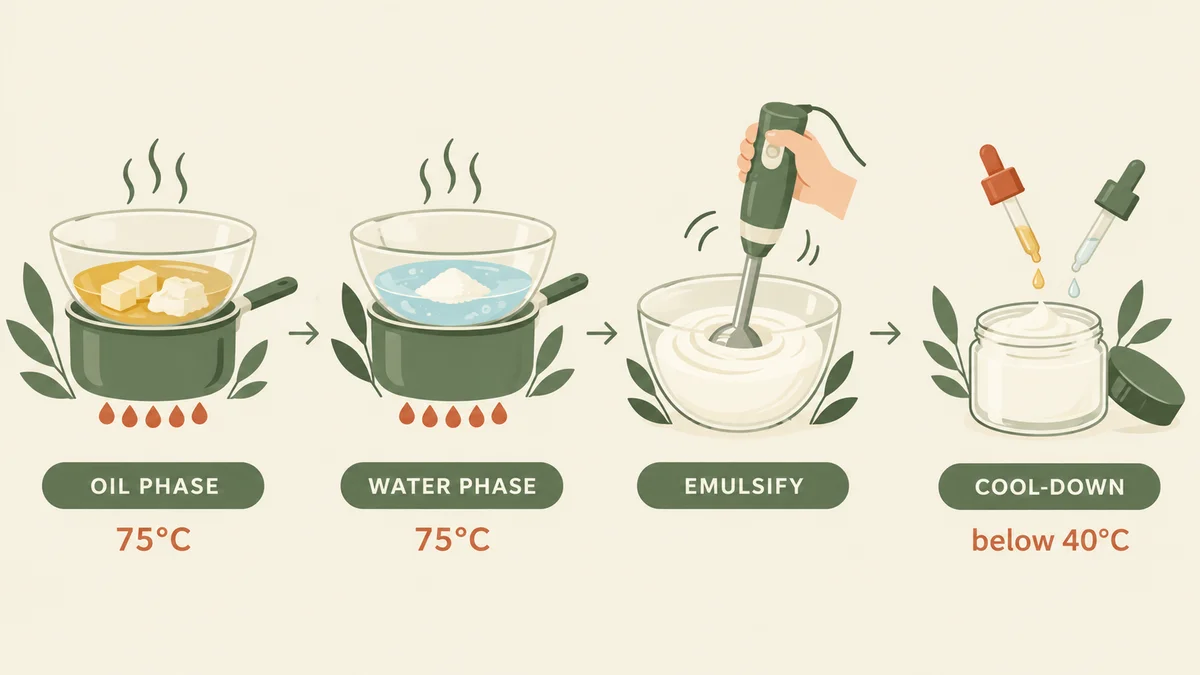
A lotion is a mix of oil and water held together by an emulsifier, with a preservative so the water does not spoil. Once you see it as four steps (heat, combine, cool, finish), a basic body lotion takes about an hour and a kitchen scale. Below is a complete formula in percentages, so you can make 100 g or 1 kg with the same page.
What you need before you start
- A scale that reads to 0.01 g (the preservative is only 1 % of the batch) and a second one to 1 g for big amounts.
- Two heat-safe glass jugs, a saucepan for a water bath, a digital thermometer and a stick blender or handheld frother.
- pH strips (range 4 to 7) or a pH meter.
- A clean pump bottle or tube. Pumps keep fingers out of the product.
- 70 % isopropyl alcohol spray to sanitise jugs, spatulas, the thermometer probe and the bottle.
- Distilled water. Tap water carries minerals and microbes.
The formula: Everyday Body Lotion (100 g)
Every ingredient is a share of the whole, and the shares add up to 100. That is what lets you scale the batch without recalculating the recipe.
| Phase | Ingredient | INCI | % | 100 g batch |
|---|---|---|---|---|
| A (oil) | Emulsifying wax NF | Cetearyl Alcohol, Polysorbate 60 | 5 | 5 g |
| A (oil) | Sunflower oil | Helianthus Annuus Seed Oil | 8 | 8 g |
| A (oil) | Shea butter | Butyrospermum Parkii Butter | 3 | 3 g |
| A (oil) | Caprylic/capric triglyceride | Caprylic/Capric Triglyceride | 4 | 4 g |
| B (water) | Distilled water | Aqua | 73.5 | 73.5 g |
| B (water) | Glycerin | Glycerin | 5 | 5 g |
| C (cool-down) | Optiphen Plus | Phenoxyethanol, Caprylyl Glycol, Sorbic Acid | 1 | 1 g |
| C (cool-down) | Vitamin E | Tocopherol | 0.5 | 0.5 g |
| Total | 100 | 100 g |
Target pH is 5.0 to 6.0. The preservative's supplier range is 0.75 to 1.5 %, and the formula uses 1 %. Always check the current data sheet for your own lot, because that sheet wins over any recipe.
Step 1: Weigh and heat the two phases
- Sanitise everything that will touch the lotion and let it air-dry.
- Weigh phase A (the wax, oils and butter) into one heat-safe jug and phase B (water and glycerin) into another.
- Set both jugs in a water bath and heat them to about 72 °C / 162 °F. Heating both to the same temperature is what keeps them from shocking each other when they meet.
Hold them at that temperature for a few minutes so the wax melts to a clear liquid.
Step 2: Combine and emulsify
Pour the water phase into the oil phase while blending. Keep the stick blender going for 2 to 3 minutes, until the mixture turns uniform and pale. This step creates the emulsion: tiny droplets of oil held in the water by the emulsifier.
Step 3: Cool while stirring
Take the jug out of the water bath and stir gently as it cools to about 40 °C / 104 °F. Do not whip air in. Heat-sensitive ingredients wait until this point on purpose.
Step 4: Add the cool-down phase, check pH and bottle
- Add the preservative and the vitamin E and stir well.
- Let a small sample reach about 25 °C / 77 °F. Mix 1 g of lotion into 9 g of distilled water for a 10 % dilution and dip the strip or probe.
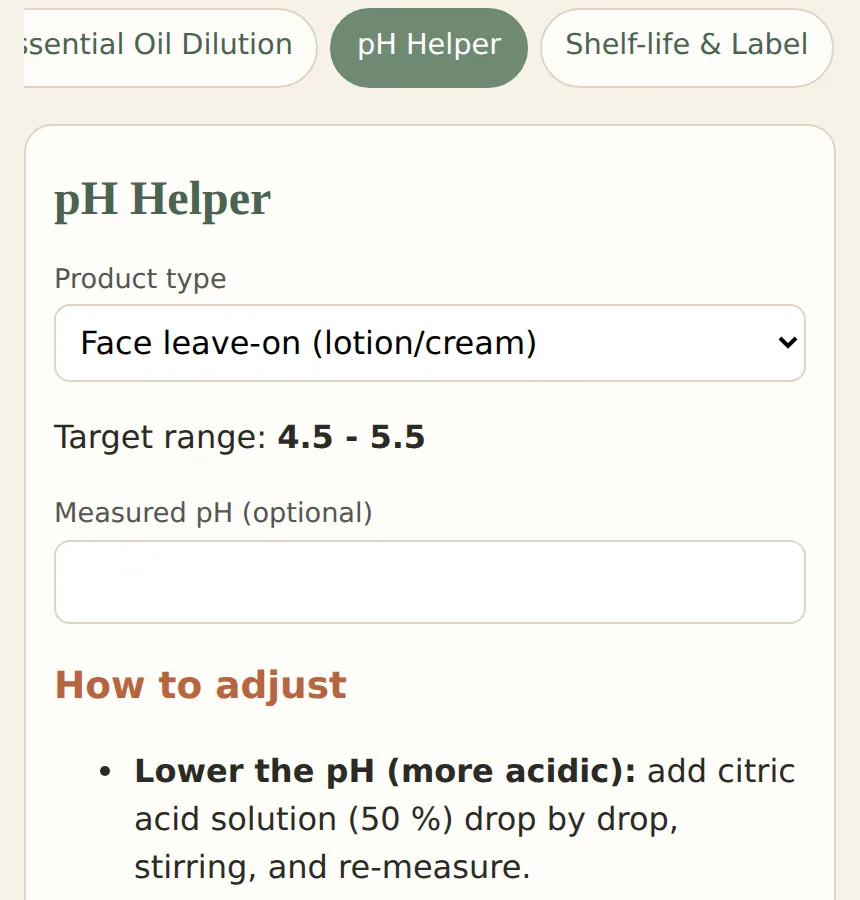
- If the pH is outside 5.0 to 6.0, add one drop at a time of a 10 % citric acid solution (to lower it) or a 10 % sodium bicarbonate solution (to raise it). Stir, wait a minute and retest.
- Pour into the sanitised pump bottle and label it with the name, batch number, date and a use-by date.
Scaling the batch
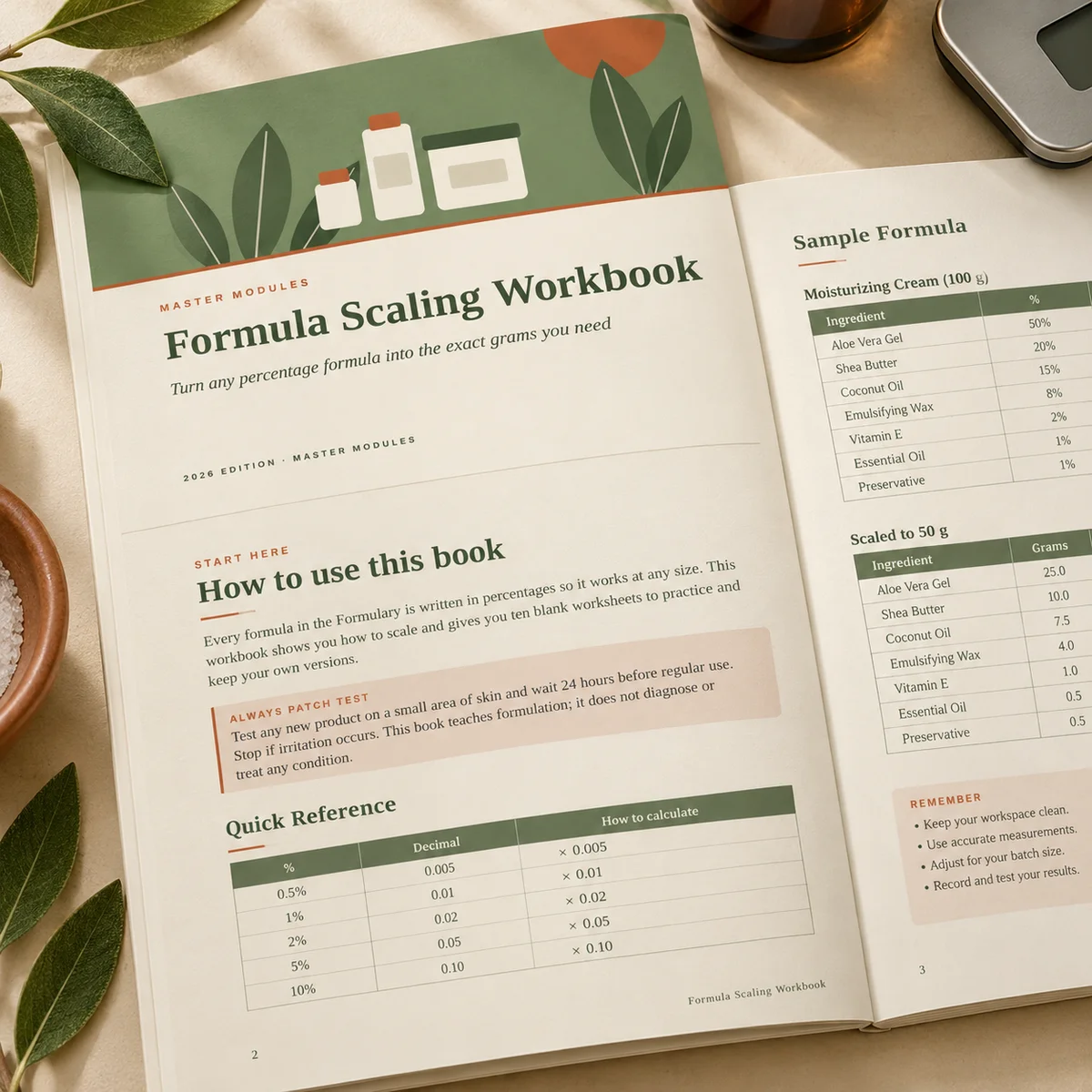
Grams = percentage × batch size ÷ 100. For a 250 g batch, emulsifying wax at 5 % is 12.5 g and the preservative at 1 % is 2.5 g. Add up every line: the total must match the batch size exactly.
Fixing the common problems
| Problem | Likely cause | What to try |
|---|---|---|
| Separates | Not enough emulsifier, phases at different temperatures, or too little blending | Match the temperatures at 70 to 75 °C, blend 2 to 3 minutes and keep stirring while it cools |
| Too thin | Too little thickener or too much water | Add 0.5 to 1 % cetyl or cetearyl alcohol next time |
| Too thick or waxy | Too much fatty alcohol or emulsifier | Reduce the thickener by 0.5 to 1 % |
| White flecks | Waxes cooled before blending | Reheat gently while stirring, blend again, then cool |
| Mould, spots or a sour smell | Contamination or a preservative problem | Discard it. Check hygiene, preservative level and pH, and make a smaller batch |
Shelf life and safety
A preserved lotion made with this process has a typical shelf life of 3 to 6 months in the formulary's tables. That is a planning range, not a guarantee, and anything that smells off, looks cloudy, changes colour or shows spots should be thrown away even before its date. Make small batches, keep the bottle in a cool, dark place and patch test on your inner forearm for 24 hours before regular use. For more on how long each type lasts, see how long homemade skincare lasts.
Swaps worth knowing
- Use BTMS-50 at 4 % plus 1 % cetyl alcohol instead of emulsifying wax NF. It gives a conditioning feel but needs a more acidic pH (see emulsifying wax NF vs BTMS-50 vs Olivem 1000).
- Swap sunflower oil for sweet almond oil in the same amount.
- To thicken, read cetyl alcohol vs cetearyl alcohol.
- To understand why the water needs protecting at all, read preservatives for homemade skincare.
Make more than one
This lotion is one of the 60 formulas in The Natural Skincare Formulary. The book is written in grams and percentages, with phases, target pH, preservative and shelf life listed for each emulsion, and a chapter on troubleshooting. It also includes a 46-ingredient guide with INCI names and typical use ranges.