How Long Does Homemade Lotion (and Everything Else) Last?
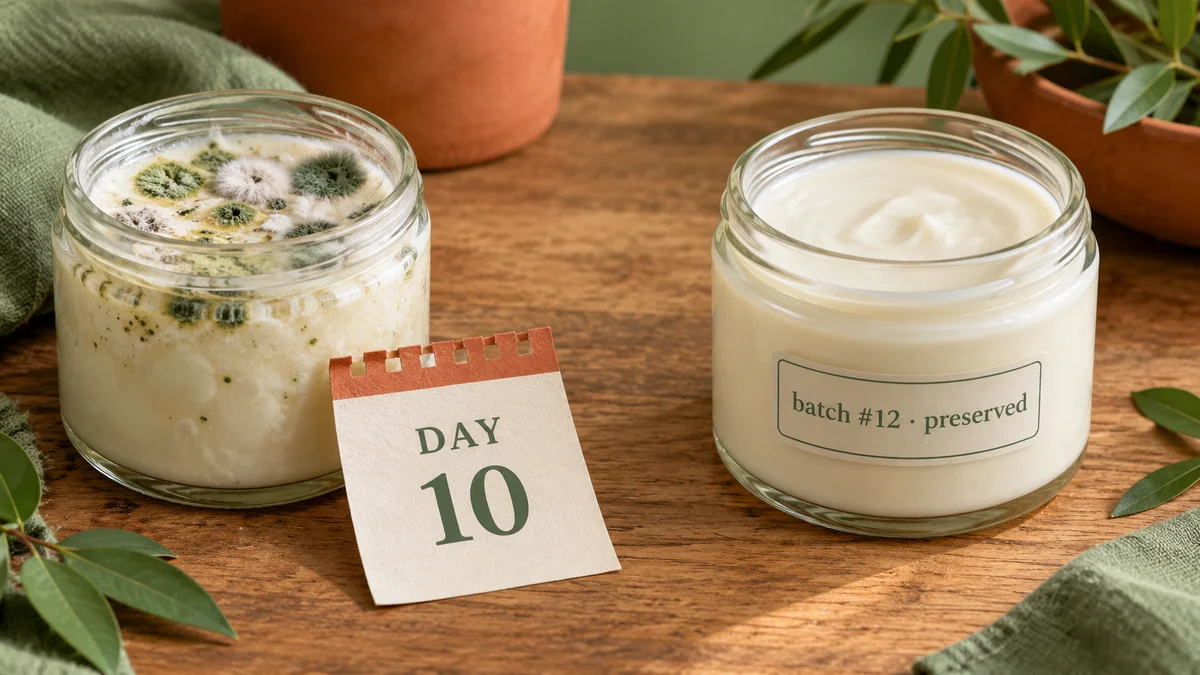
How long a homemade product lasts depends on one question: does it contain water? Products without water (balms, butters, bars, oil blends, dry powders) are given months. Products with water need a preservative, are given a shorter window and still spoil early if the process was not clean. This page puts typical figures side by side, then walks through what shortens a shelf life and how to tell when a batch is done.
The short answer by product type
These are the ranges used in the Storage chapter of The Natural Skincare Formulary. They are planning ranges for personal use, not guarantees.
| Product type | Typical shelf life | Storage |
|---|---|---|
| Anhydrous balms, butters and bars | 6 to 12 months | Cool, dark place, closed lid |
| Oil serums | 6 to 12 months (3 to 6 with sensitive oils such as rosehip or hemp) | Dark glass bottle, cool, dark place |
| Preserved emulsions (lotions and creams) | 3 to 6 months, per preservative and process | Pump bottle or tube if possible, in a cool, dark place |
| Preserved aqueous products (toners, gels) | 1 to 3 months | Cool place, small bottles |
| Powders (clay masks) | 6 to 12 months | Dry, sealed jar. Add water only just before use |
Anything that contains water, aloe, a hydrosol or a juice and has no preservative supports microbial growth within days. That is why every water-containing recipe in the book carries a preservative.
Shelf life by recipe
Each formula in the book lists its own figure. Here is a sample, to show how much the range moves between products:
| Product | Type | Planned shelf life |
|---|---|---|
| Classic Beeswax Lip Balm | Anhydrous | 9 to 12 months |
| Silky Whipped Body Butter | Anhydrous | 6 to 9 months |
| Soft Sugar Body Scrub | Anhydrous | 6 months |
| Classic Fizzy Bath Bomb | Anhydrous, keep dry | 3 to 6 months |
| Solid Lotion Bar | Anhydrous | 12 months |
| Everyday Body Lotion | Emulsion | 3 to 6 months |
| Rich Hand Cream | Emulsion | 3 to 6 months |
| Light Face Cream | Emulsion | 3 to 4 months |
| Aloe Gel-Cream Moisturizer | Emulsion | 3 months |
| Lavender Hydrosol Toner | Aqueous | 3 to 4 months |
| Rose Hydrosol Toner | Aqueous, refrigerated | 1 to 2 months |
| Natural Solid Perfume | Anhydrous | 12 months |
Why water changes everything
Water is a food source for bacteria, yeast and mould, and they can grow without obvious signs. A preservative used at the rate and pH its supplier states makes a water-based product resist that growth for a while. It does not make a dirty batch clean. The formulary puts it this way: preservatives protect a clean product, they do not rescue a dirty one. For a closer look, read preservatives for homemade skincare and the lotion method.
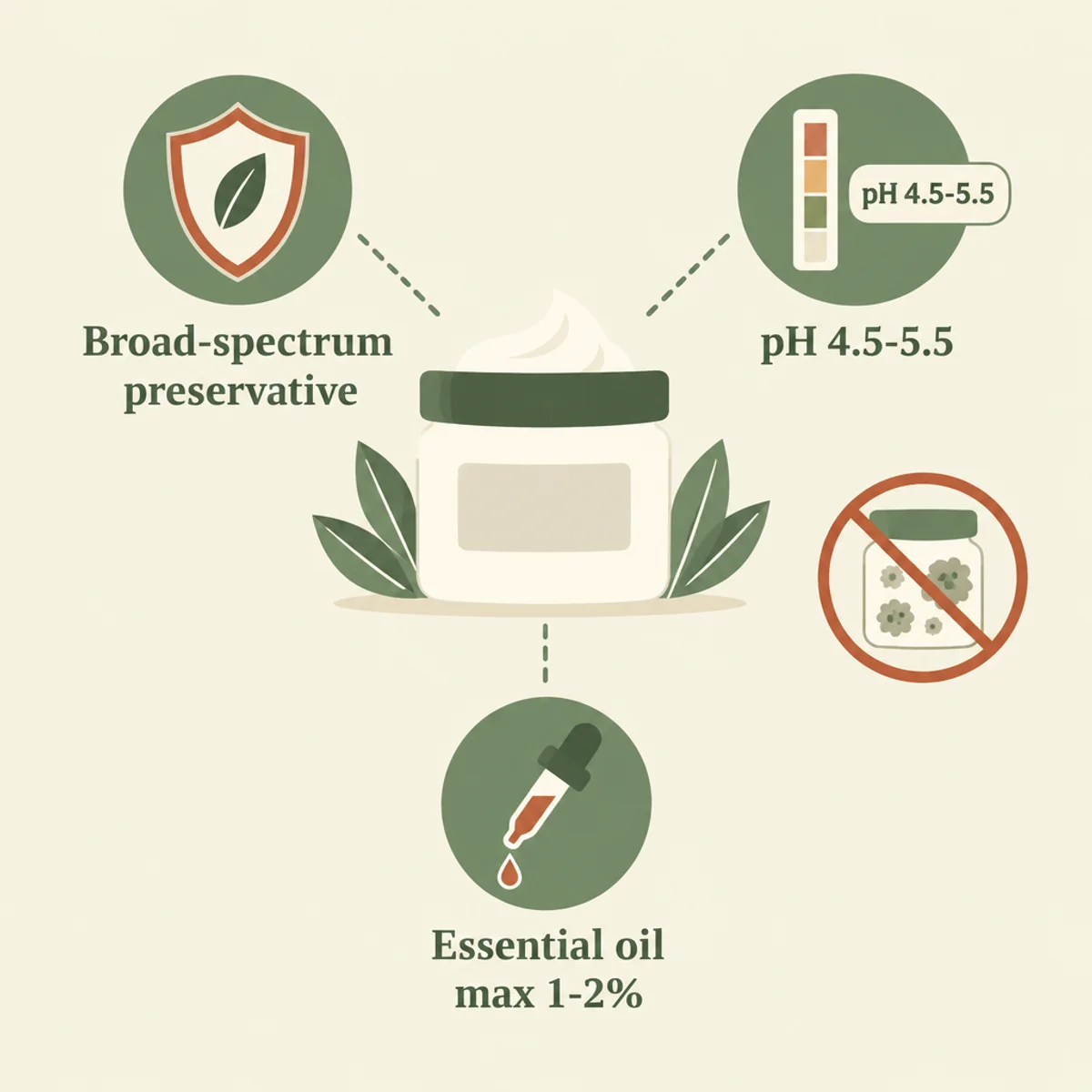
Vitamin E is not a preservative against bacteria or mould. It is an antioxidant that slows rancidity of the oils, and that is a different problem.
What shortens a shelf life
- Contamination. Fingers in a jar, unsanitised tools, tap water and wet scoops all add microbes. Use pumps and tubes for water-based products.
- Heat, light and air. They speed up oxidation. Use opaque or amber containers for oils and light-sensitive products.
- Fast-oxidising oils. Sunflower, rosehip, hemp and grapeseed oils oxidise faster than jojoba, squalane or fractionated coconut oil.
- Humidity. Bath bombs, shower steamers and scrubs are ruined by water. Keep them dry.
- Wrong pH or preservative level. A preservative has a working pH window, and the recipe's rate has to stay inside the supplier's range.
When to throw it away
Discard a product, whatever its date, if:
- it smells off, sour or like crayons or paint;
- it looks cloudy or has changed colour;
- it shows spots, fuzz or any visible growth;
- it has separated in a way it never did before;
- or you simply are not sure.
If you are in doubt, throw it out. The cost of a small batch is far less than the cost of a problem.
How to give each batch a date
- Write the name, batch number and date made on the container the same day.
- Add a use-by date based on the recipe's shelf life, counted from the date you made it.
- Note any change you made to the recipe in a batch log, so you can connect what you did with how it aged.
- Keep the full ingredient list (INCI) on the label.
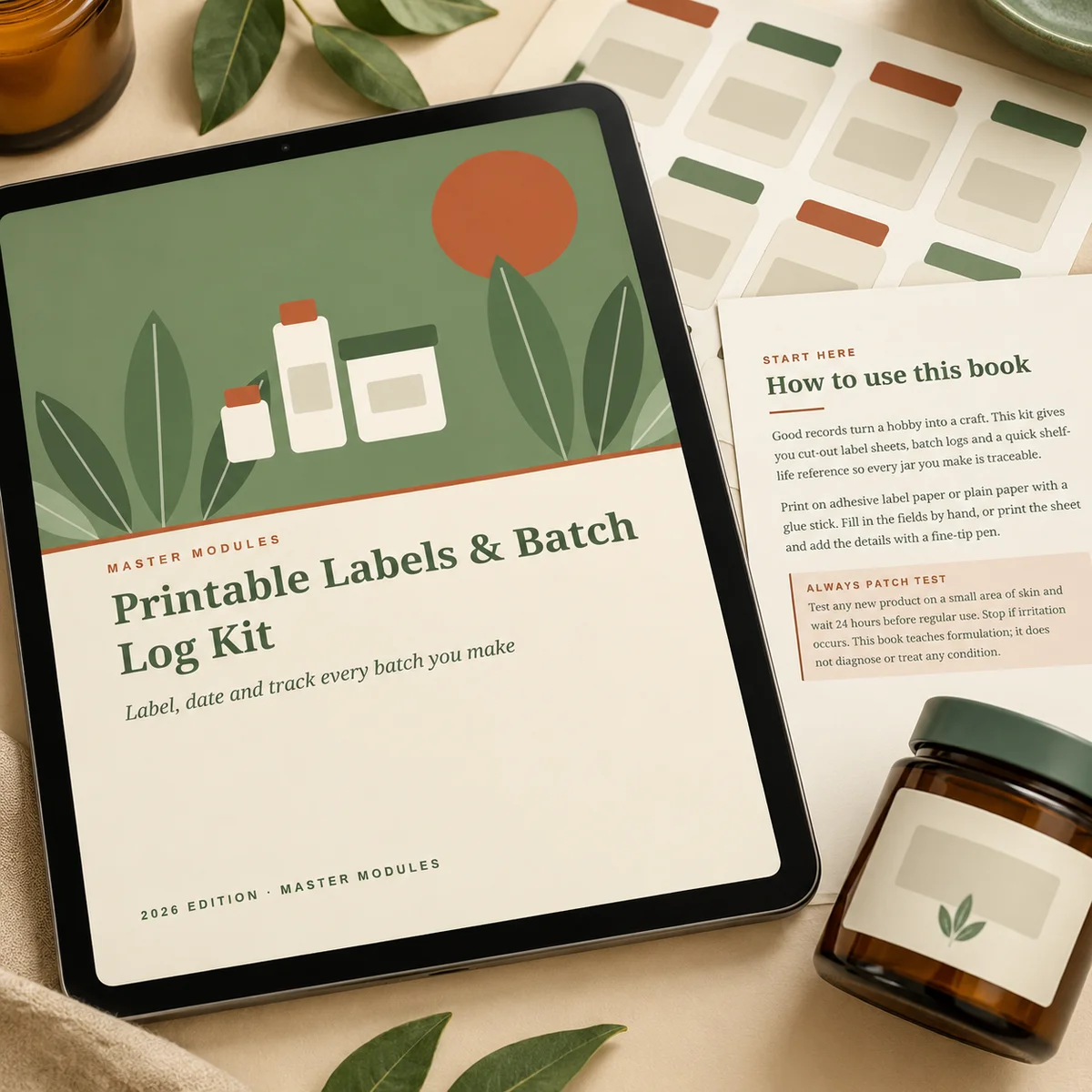
The labelling checklist in the label and batch log guide shows what belongs on each label. The labelling chapter in the book, plus the batch log pages and the web app's Shelf-life & Label tool, cover the same ground.
A quick routine for longer-lasting batches
- Make small batches of anything with water, and finish them within the window.
- Sanitise jars, lids, spatulas and your work surface with 70 % isopropyl alcohol and let them air-dry.
- Use distilled water for water phases.
- Add the preservative in the cool-down phase at the supplier's rate.
- Check the pH of every water-based batch against the target in the recipe.
- Fill, close and label as soon as the batch reaches the right temperature.
- Store cool and dark, and prefer pumps and tubes to wide jars.
Not sure where to start?
If you are just getting started, the water-free recipes are the most forgiving. A lip balm is given 9 to 12 months and needs no preservative. You can build up to a lotion once the routine feels familiar.
Where these figures come from
Every formula in The Natural Skincare Formulary lists its batch size, time, shelf life and, for water-based products, a target pH and a preservative rate. The Storage, Shelf Life & Labelling chapter holds the table above, and a 12-month seasonal calendar covers how weather changes what you should make and when.