Cetyl Alcohol vs Cetearyl Alcohol in Homemade Cream
Cetyl alcohol and cetearyl alcohol are fatty alcohols: waxy solids that thicken creams and lotions and help them stay stable. Despite the word "alcohol" in the name, they are not the thin, evaporating alcohol in a bottle of rubbing alcohol. In a homemade cream they act more like a wax, and a small change in the amount changes how thick the finished product feels.
At a glance
| Cetyl alcohol | Cetearyl alcohol | |
|---|---|---|
| INCI | Cetyl Alcohol | Cetearyl Alcohol |
| Group in the ingredient guide | Thickeners | Thickeners |
| Use range | 1 to 5 % | 1 to 5 % |
| Phase | Oil | Oil |
| Described as | A fatty alcohol that thickens and stabilises emulsions | A fatty alcohol that thickens creams and lotions |
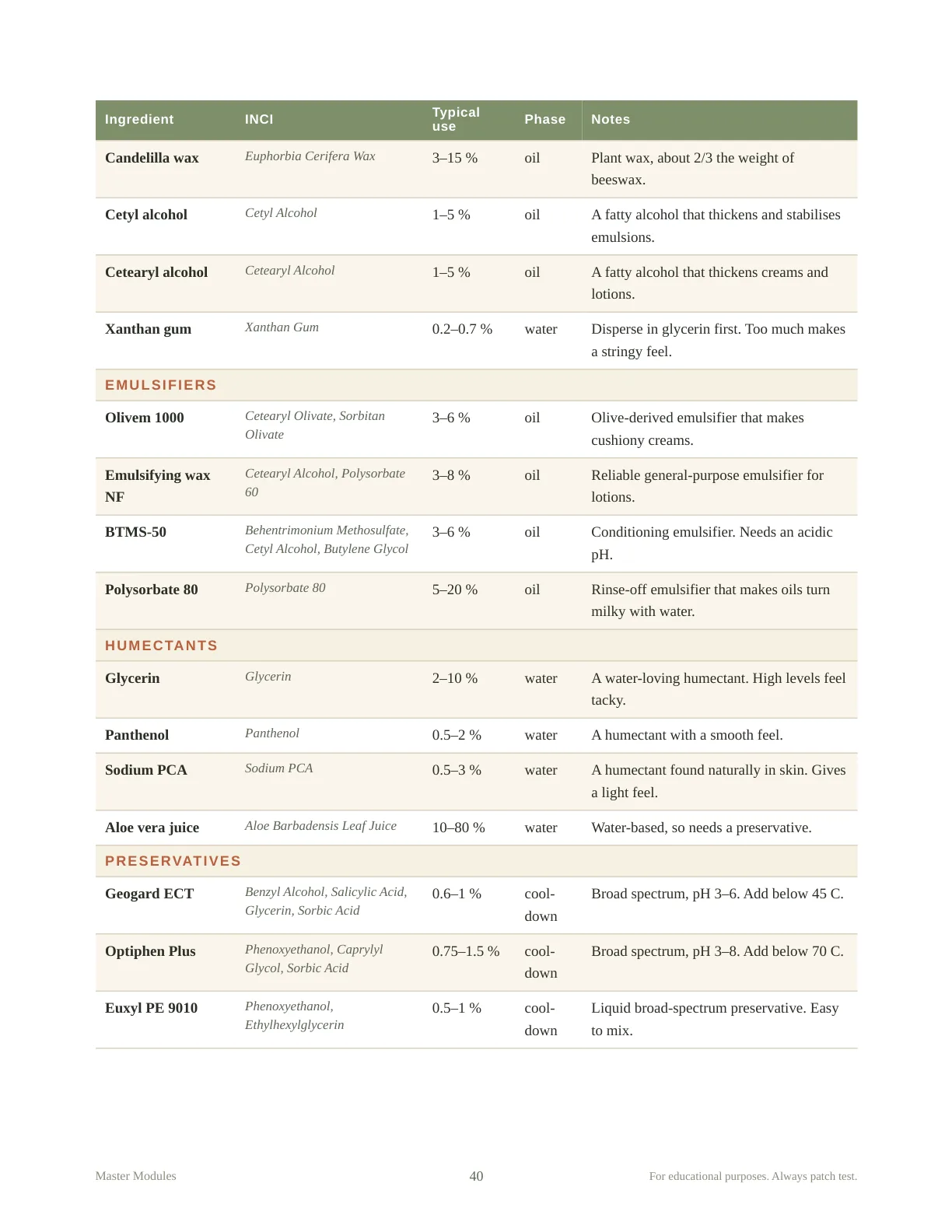
Cetearyl alcohol is a blend of fatty alcohols that includes cetyl alcohol, which is why the two are so close in the way they are used. The formulary treats them as interchangeable for thickening in its troubleshooting step.
What they do
- Thicken. A small percentage turns a thin, runny lotion into something with body.
- Stabilise. Together with an emulsifier, fatty alcohols help the emulsion hold.
- Shape the texture. More makes a thicker, waxier product, and less makes it more fluid.
They are not emulsifiers on their own. You still need an emulsifier such as emulsifying wax NF, BTMS-50 or Olivem 1000 to hold the oil and water together. See the three-emulsifier comparison.
Where they appear in the formulas
| Formula | Emulsifier | Fatty alcohol |
|---|---|---|
| Light Face Cream | Olivem 1000, 5 % | Cetyl alcohol, 1.5 % |
| Rich Hand Cream | BTMS-50, 4 % | Cetyl alcohol, 2 % |
| Everyday Body Lotion | Emulsifying wax NF, 5 % | None added (the emulsifier already contains cetearyl alcohol) |
Two details are worth noticing. First, the emulsifying wax NF in the lotion is itself made of cetearyl alcohol and polysorbate 60, and BTMS-50 contains cetyl alcohol, so an emulsifier can already supply some of the thickening. Second, the swap listed for the body lotion, BTMS-50 at 4 % plus 1 % cetyl alcohol, shows how a fatty alcohol is added to rebuild the body when the emulsifier changes.
How to use them
- Weigh them with the oil phase. They go into phase A, with the oils, butters and emulsifier.
- Heat until fully melted, to the same temperature as the water phase (for most of the formulary's emulsions, 70 to 75 °C / 158 to 167 °F).
- Combine and blend for 2 to 3 minutes, then stir while the product cools.
- Judge the result the next day. Lotions thicken for about 24 hours after you make them.
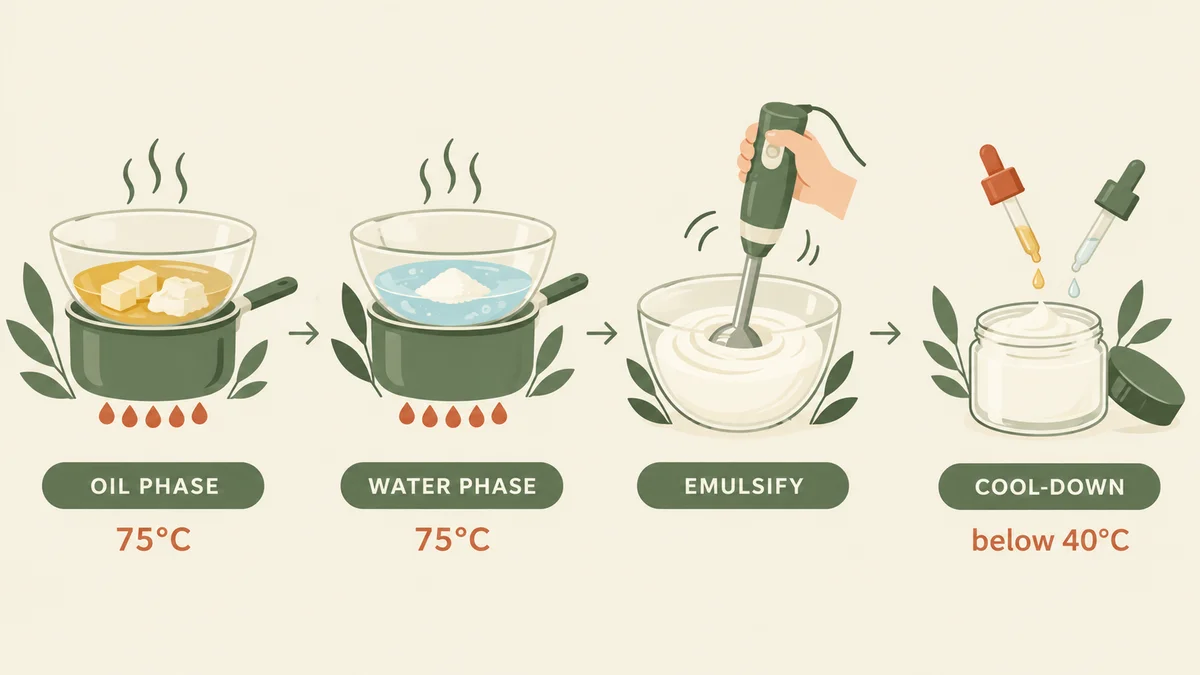
For the full method, see how to make lotion.
Fixing a lotion that is too thin or too thick
| Problem | Likely cause | What to try |
|---|---|---|
| Lotion too thin | Too little thickener or too much water | Add 0.5 to 1 % cetyl alcohol or cetearyl alcohol in the next batch |
| Lotion too thick or waxy | Too much fatty alcohol or emulsifier | Reduce the thickener by 0.5 to 1 % in the next batch |
| White flecks or pearls in a cream | Waxes cooled before blending | Reheat gently while stirring or blend again, then cool |
| Separation | Not enough emulsifier, mismatched phase temperatures or too little blending | Heat both phases to the same temperature, blend 2 to 3 minutes and keep stirring while cooling |
The rule that applies to all of these is simple: change one variable at a time, and write the change in your batch log. If you change the emulsifier, the fatty alcohol and the oil all at once, you will not know what worked.
Working in percentages
Because fatty alcohols are so powerful, a small change in grams matters. In a 100 g batch, 0.5 % is only 0.5 g, and that needs a scale that reads to 0.01 g. If your scale reads to 1 g, make a larger batch so the tiny amounts stay accurate. Grams equal percentage times batch size divided by 100: 1.5 % of 250 g is 3.75 g.
Reading a formula that uses them
When you read a cream formula, look for the fatty alcohol in phase A, next to the emulsifier. Ask three questions. How much emulsifier is there, and does it already contain a fatty alcohol? How much extra thickener has been added? And what is the total of both? In the Rich Hand Cream, BTMS-50 at 4 % and cetyl alcohol at 2 % sit beside 5 % shea butter, 6 % sweet almond oil and 4 % caprylic/capric triglyceride, which is a dense, cushiony cream. In the Everyday Body Lotion, the 5 % emulsifying wax NF is the only thickener, and the result is a fluid, spreadable lotion. The pattern is simple: the more fatty alcohol across the formula, the thicker and waxier the product.
Swapping one for the other
Use the same percentage when you replace cetyl alcohol with cetearyl alcohol in a thickening step, then test the next day. Cetyl alcohol also appears in the swap cheat sheet as a replacement for beeswax at 1.5 times the amount, which gives a creamier, less sticky result, but it is not suitable for lip glosses.
Where these fit in the bigger picture
A cream is a stack of choices: an emulsifier, a thickener, oils and butters, a humectant, a preservative and a pH target. The natural skincare ingredients guide shows how those groups fit together. If you have not made an emulsion yet, DIY skincare for beginners suggests making water-free batches first.
The ingredient guide in the book
The Natural Skincare Formulary includes entries for both fatty alcohols in its 46-ingredient guide, along with INCI names, use ranges and phases. Each cream and lotion formula lists the percentages, the phase order and the target pH, and the Troubleshooting chapter has the thin and thick lotion fixes above. A separate Troubleshooting Field Guide bonus covers 47 problems with causes and fixes.